

What Building a Product in 3 Weeks Taught Us About Framework Trade-offs
Let’s have a look at how we used MeteorJS for our new, totally free
In case you haven’t noticed yet, our UX family is richer for a new member! Namely, Koncept got its little brother – UsabilitySquare.
What Is This Square About?
We’ll be honest with you – unlike Koncept, UsabilitySquare wasn’t really planned. The idea for UsabilitySquare just came to us, so we decided to create it out of pure love for (obviously 😀) usability.
The best thing about UsabilitySquare is that it turned out to be altruistically inclined. Namely, it represents a place where everyone interested in validating their ideas can connect with usability enthusiasts and get totally free, instant and unbiased feedback from real people.
Giving MeteorJS a Chance
From the very moment, we decided to create UsabilitySquare, we saw it as an opportunity to try out some new tools and frameworks. The MeteorJS platform won the contest, so the fun could start!
Meteor’s reactive data (real-time updates over DDP) and instant changes on the interface were a real treat to work with. They allowed us to provide users with a smooth experience without writing hundreds of lines of code.
MeteorJS: The Good Parts
These real-time functionalities are generally seen as one of the major merits of using Meteor. Thanks to these features, the end product always feels snappy and responsive for the end-user. This is due to the interesting paradigm of “the Optimistic UI” – Meteor assumes that operations are successful and updates the interface instantly.
Implementing this concept from scratch would be a very difficult and time-consuming task, but Meteor handles the issue right out of the box. This is done via a client cache (Minimongo) that can be used for quick (but temporary) client-side updates. This compensates for the wait time and Network latency of persistent database operations. When the operations finish, Meteor handles conflicts between the client and server and does all the work that’s needed to patch the UI with real results.
This is how, simply expressed, “Optimistic UI” update cycle looks like:
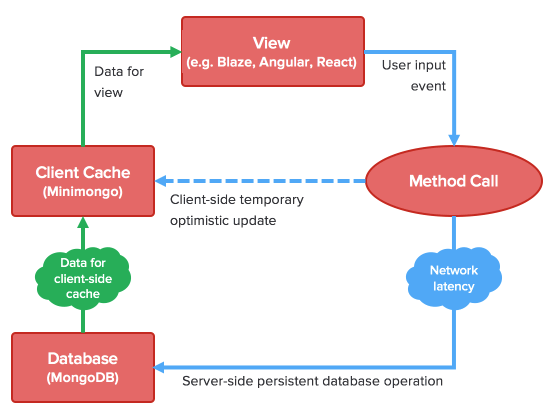
It’s good to note that we used React for our Views (instead of the Blaze templating engine that is provided by Meteor) and that everything worked just fine.
As developers we also enjoyed working with Meteor’s Publish / Subscribe / Call model which made it very simple to create interactions between client and server-side code. This allows quick interactions and a reactive data flow over the DDP-enabled web socket APIs.
The Drawbacks of MeteorJS
However, there are certain problems with MeteorJS that simply prevent us from using it on larger projects in the future:
Using Meteor means using MongoDB - in fact the entire concept of Meteor’s Optimistic UI is dependant on Mongo and its cache. While MongoDB is great, it’s not always what you need or want to use.
The build system and tests have been painfully slow for us, especially as the project grows.
The amount of control that developers are given over the Meteor core is minimal. This is fine if you’re okay with “marrying into the Meteor platform”, but it just isn’t for us.
Besides the revelations regarding MeteorJS that we got thanks to UsabilitySquare, it also confirmed us that people are honestly interested in ways to get simple and fast validations for their ideas.
We Had a Great Time!
The secret of our Square’s adorableness lies in all free information one can get from real people who are gathering here, willing to help each other.
Simplicity also plays important role, since the whole ‘procedure’ is consisted out of just 3 steps. In short: Everything one should do in order to get feedback is to set an experiment and ask other Squarers how they would answer certain question about their project.
Interested to get some free and unbiased feedback? Don’t hesitate to try out UsabilitySquare then. Also, don’t forget to share your impressions and suggestions with us! As usual: we’re all ears! :)
Related Insights
Insight
KonceptApp: Best National Cloud/Data Application!
KonceptApp just won Best National Cloud/Data Application! See how our high-fidelity prototyping tool solves major UX pain points with real-user testing and animations.
Read More
Insight
Adopting the Product Mindset in a Project-driven World
Why does software success depend on team mentality? Discover how shifting from a project mindset to a product mindset helps teams focus on solutions, not just technology.
Read More
Insight
Why We Chose React Native for Mobile Development
Native vs. cross-platform? We chose React Native to build value-driven products faster. Learn how to cut development costs without sacrificing user experience.
Read More
Insight
Prototyping in Production: Risk-Tolerant Engineering in the Real World
"Fail fast" fuels innovation, but does it apply to critical systems? Discover risk-tolerant engineering strategies for prototyping when failure is not an option.
Read MoreReady to build something amazing?
Let's discuss how we can help transform your vision into reality.