

Engineering Medical Devices from Silicon to Clinical Workflow
Moving telemetry from a medical device into a clinical workflow requires more than working hardware. This guide details the 6-layer architecture, from firmware and BLE gateways to FDA 524B compliance and RPM billing, needed to ship connected medtech into live clinical environments.
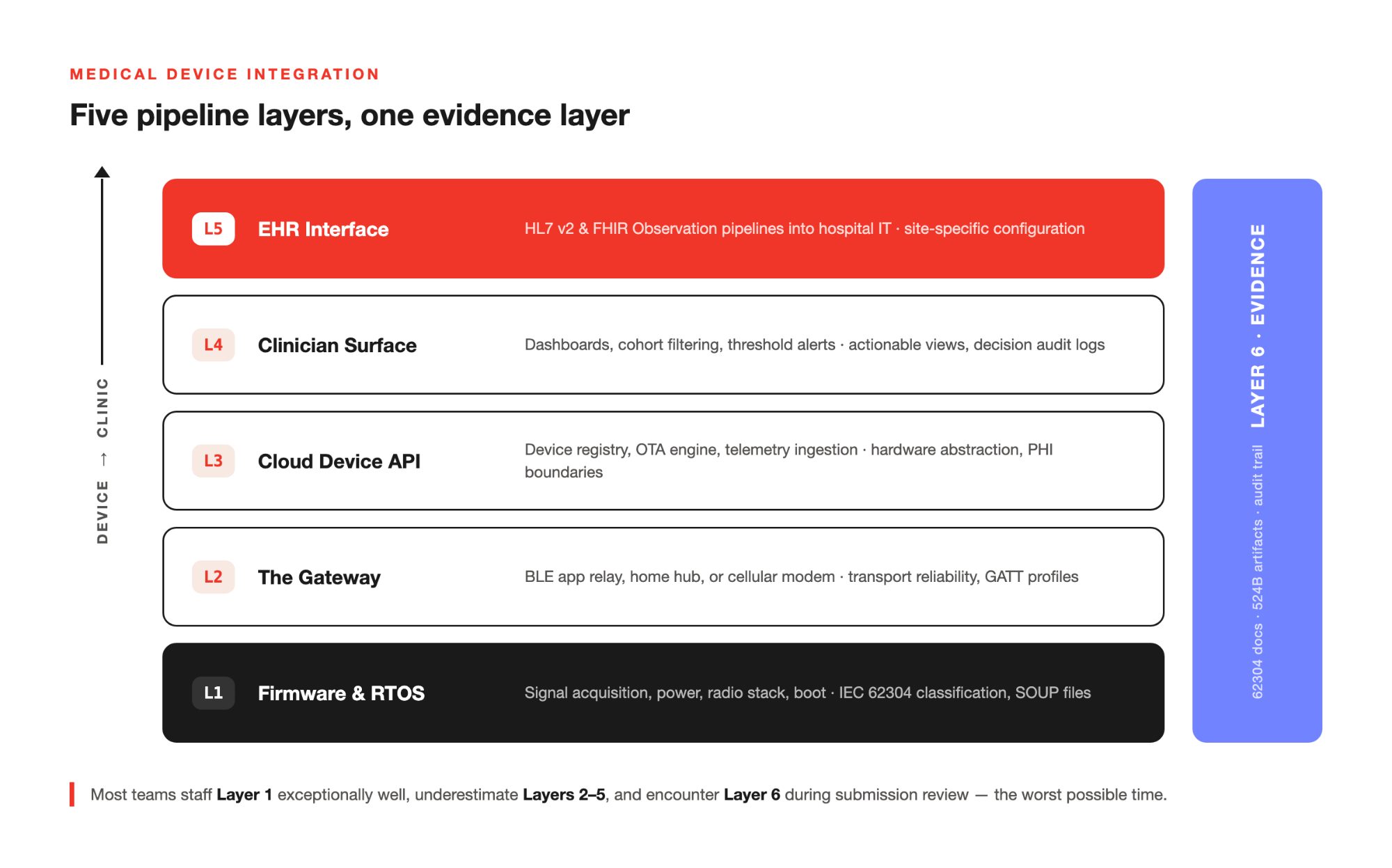
Medical device integration requires moving data from a regulated hardware device directly into clinical workflows. That pipeline spans five distinct engineering layers: firmware on the device, the gateway, the cloud device API, the clinician-facing surface, and the EHR interface. A sixth layer crosses all five: the evidence layer, which encompasses IEC 62304 lifecycle documentation, FDA Section 524B cybersecurity artifacts, and the end-to-end audit trail proving the underlying system functions safely.
Most medical device teams staff layer one exceptionally well, underestimate layers two through five, and encounter layer six during submission review, which is the worst possible time to address it.
(This guide details the end-to-end architecture from the device maker's perspective, using the telemetry and intelligence platform we engineered for an FDA-authorized smart knee implant as our primary technical reference.)
The Architecture at a Glance
Navigating commercial categories like "medical device middleware" or "health IT gateways" often means dealing with vendors operating at completely different layers of the stack. Hospital-side middleware vendors sell bedside device aggregation to health systems, interface engines handle internal message routing for hospital IT networks, and integration networks sell EHR connectivity as a managed service. Each vendor stops at their specific layer boundary, meaning none of them build your end-to-end product.
Layer 1: Safety Classifications Dictate System Architecture
IEC 62304 assigns your software a safety class based on potential risk: Class A for no injury, Class B for non-serious injury, and Class C for death or serious injury. Class C software requires unit-level architectural documentation, complete unit verification, and strict memory and execution segregation.
Enforcing strict segregation allows a Class C therapeutic core to run alongside Class B connectivity features without elevating the entire codebase to Class C rigor. This separation requires physical hardware isolation, such as separate MCU cores, MPU-enforced memory partitioning, or a certified hypervisor, because software folder structures or logical abstractions do not satisfy regulatory requirements for segregation.
Shipping Zephyr in Class II medical devices is common practice, but it carries clear compliance trade-offs. Under IEC 62304, Zephyr is categorized as Software of Unknown Provenance (SOUP) because it is incorporated into a device but was not developed under your internal 62304 quality system. For Class B and C software items, incorporating Zephyr requires addressing an explicit regulatory checklist:
- SOUP requirements specifications defining exact hardware dependencies and memory allocations per clauses 5.3.3 and 5.3.4.
- Targeted anomaly reviews auditing the public Zephyr issue tracker against your pinned LTS release per clause 7.1.3.
- Failure mode risk analyses mapping system safety reactions when the scheduler or BLE stack fails.
- Active vulnerability tracking covering upstream CVEs for the operational lifetime of the device.
For Class A and B devices, Zephyr represents a strong choice due to its modern toolchain and SBOM-friendly build system, provided you allocate resources to manage the SOUP documentation package. For Class C items, evaluate commercial RTOS options that bundle complete 62304 validation kits against the internal engineering burden of qualifying open-source software manually.
Layer 2: Managing Gateway Failure Modes
The firmware team’s scope typically stops at the radio layer, while the cloud team’s pipeline begins at ingestion. The gateway layer bridging these systems is frequently left unowned, creating severe field reliability issues post-launch.
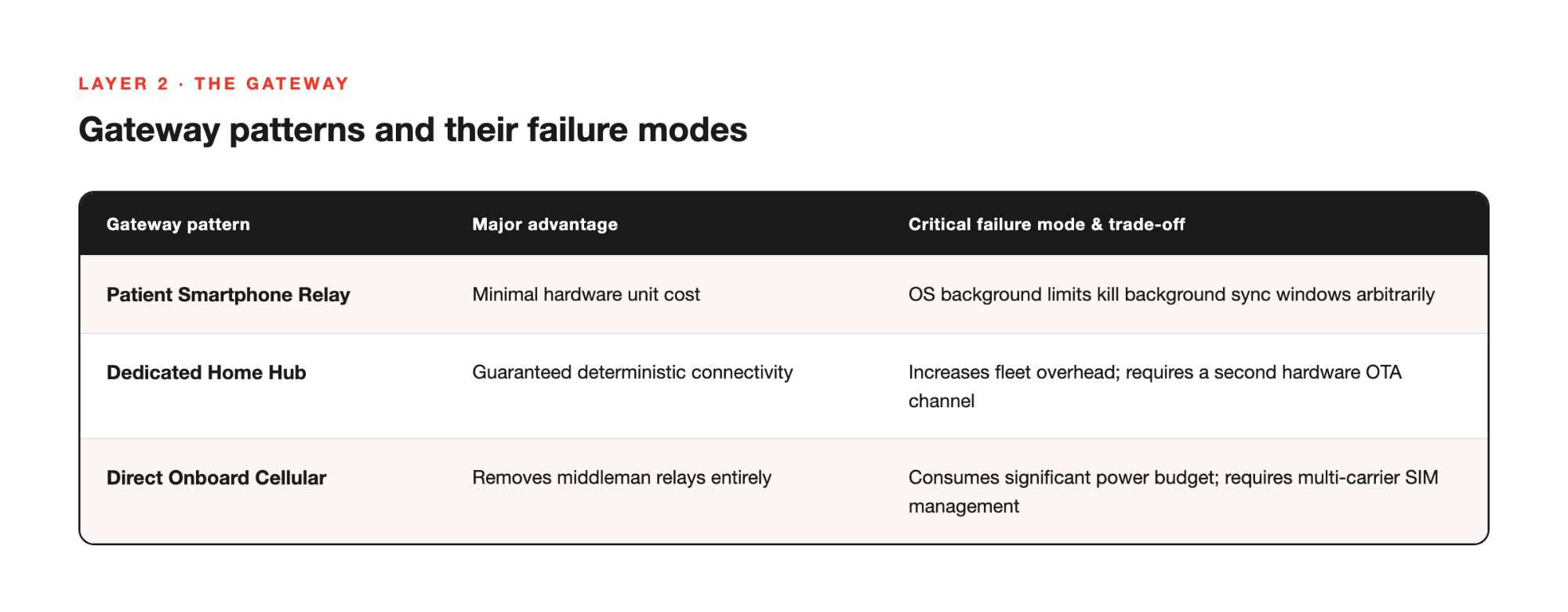
Smartphone relays carry the lowest hardware cost but introduce extreme environmental variability as mobile operating systems aggressively throttle background BLE tasks, suspend unoptimized applications, and disrupt sync windows. Dedicated home hubs eliminate background OS throttling at the expense of fleet management overhead, while direct onboard cellular (LTE-M/NB-IoT) trades power budget and antenna design against complete relay independence.
Layer 3: Building the Proprietary Cloud Device API
The cloud device API represents your core technical asset, housing your proprietary domain model, device management logic, and longitudinal telemetry storage. Hardware revisions accumulate over long product lifecycles, making a hardware abstraction layer essential for decoupling capability differences across device generations from downstream clinical consumers. This API must also host a staged OTA engine to deliver security patches under Section 524B mandates, featuring remote rollbacks and cryptographic signature validation.
Telemetry transforms into Protected Health Information (PHI) the moment device identifiers bind to patient identity records. Maintaining strict architectural separation between the device management plane and the patient identity plane limits HIPAA breach boundaries and simplifies security audits.
Layer 4: Designing Clinician-Facing Surfaces
Clinical teams face high notification volume across systems, meaning portals that require separate authentication steps or emit non-actionable alert noise see rapid clinical abandonment. Clinician surfaces should be designed around prioritized patient cohorts rather than raw sensor outputs, allowing care teams to adjust notification thresholds based on individual patient baselines to minimize false-positive notifications. All alert generations, view receipts, and clinical escalations must be logged within the system log to serve as the primary operational record when evaluating clinical decision accuracy during retrospectives.
Layer 5: Modernizing the EHR Transport Layer
Device data reaches the EHR primarily via HL7 v2 ORU messages or FHIR Observation and DocumentReference resources. Selecting an integration pattern requires evaluating infrastructure control versus operational overhead across available market solutions.

Building an internal EHR integration layer requires maintaining site-specific VPN tunnels, managing legacy transformation engines, and coordinating field testing across health system interfaces. Engineering resources deliver higher return when focused on layers one through four, where proprietary hardware and algorithm IP reside.
Section 524B Mandates Regulate the Entire Pipeline
FDA statutory authority under FD&C Act Section 524B applies cybersecurity requirements to any cyber device containing software capable of connecting to the internet, directly or indirectly. A Bluetooth Low Energy connection to a smartphone app brings the entire data pipeline under regulatory scope.
Submissions subject to 524B require a strict regulatory documentation package:
- A machine-readable Software Bill of Materials (SBOM) listing all open-source libraries, RTOS dependencies, firmware components, and commercial drivers.
- Structured patching plans proving remote vulnerability mitigations reach fielded hardware reliably.
- Automated vulnerability tracking matching system components against newly published CVE databases throughout the product lifecycle.
Integrating SBOM management into your build pipeline generates security documentation automatically, avoiding manual documentation assembly prior to regulatory filings.
Aligning Data Architecture with Remote Patient Monitoring (RPM)
Remote Patient Monitoring reimbursement under CPT codes directly links pipeline transmission reliability to revenue generation.

CPT 99454 requires valid device transmissions on at least 16 days out of a 30-day window, meaning missing transmission windows directly impacts monthly billing eligibility. Data pipelines must automatically aggregate daily payload validity per patient, track sync drop-offs, and categorize underlying causes (such as hardware offline or app background execution killed) to protect subscription revenue.
Case Study Architecture: FDA-Cleared Smart Knee Implant
The telemetry and intelligence platform developed in our Canary Medical case study (supporting the FDA De Novo-authorized Persona IQ smart knee implant alongside Zimmer Biomet) illustrates this end-to-end architecture. The embedded sensor package streams six continuous gait telemetry signals directly from within the knee joint on multi-year battery reserves. These signals flow into an Azure-based ML ingestion pipeline feeding a long-term database designed for decade-scale continuous kinematic storage.
High-level recovery tracking dashboards display objective gait metrics to surgeons without requiring manual signal processing, while automated telemetry logs support RPM billing processes generating recurring monthly monitoring revenue. Building this architecture as a unified system ensured compliance artifacts, audit controls, and data interfaces were fully integrated prior to submission.
Technical Audit: Four Questions Before Deployment
To evaluate your system's integration state, assess your architecture against these four practical checks:
- Have you mapped background execution constraints, OS updates, and Bluetooth reconnect logic across both iOS and Android environments under real-world conditions?
- Does your Cloud API abstract hardware capabilities, or will firmware modifications in generation two break downstream telemetry pipelines?
- Can your pipeline generate an up-to-date SBOM covering both firmware libraries and RTOS components for immediate review?
- Does your telemetry engine calculate valid patient transmission days per 30-day window to support RPM billing requirements?
Moving Medical Devices into Production
The physical hardware device typically accounts for roughly one-third of overall system development. The remaining software architecture, evidence generation, and data pipeline components govern clinical adoption and recurring revenue models. Our First Build works directly with medical device and health-tech teams on these integration layers: about a month that establishes layer architecture mapping, build-versus-buy decisions, automated compliance tooling, and a validated production roadmap.
If your device hardware is validated and ready for live clinical integration, schedule a call with our integration engineering team.
Related Insights

Insight
Your AI Cleared the FDA. Now You're Afraid to Improve It.
Medtech teams freeze their AI models after clearance because touching the model seems to mean going back to the FDA. The PCCP framework changes that math, but only for teams that built the evaluation infrastructure to use it.
Read More
Insight
When Your Production AI Fails, the Clock Is Already Running
When your FDA-cleared AI makes a wrong call in production, post-market surveillance is an engineering problem long before it's a paperwork one.
Read More
Insight
Continuous V&V: Overcoming the Compliance Loop in Safety-Critical AI Systems
How do you deploy industrial AI with change control a regulator will accept? Define the model's adaptation boundaries up front, run V&V continuously in the pipeline rather than at release, scope re-validation through impact analysis, and keep experts on the flagged cases. FDA CSA, GAMP 5 D11 and PCCPs now expect it.
Read MoreFacing a problem like this one?
Tell us what the business needs to win and who owns it on your side. If it is a fit, a First Build starts within weeks. If it is not, we will tell you why.